2026-05-12
SBA Preferred Lender Program (PLP): What It Means for Your Loan
By Kevin Bartley
In fiscal year 2024, the SBA approved over 70,000 loans for the 7(a) program, totaling more than $31 billion. These loans financed businesses across the United States, from gas stations, to assisted living facilities, to hair salons.
Traditional SBA loan approval can drag on for months, with multiple rounds of underwriting between the lender and the SBA. For small business owners, that can scuttle time-sensitive opportunities, such as closing a commercial property.
The SBA Preferred Lender Program (PLP) can speed up the loan approval process for 7(a) loans. PLP lenders can approve SBA 7(a) loans on the agency's behalf, reducing the funding process by weeks or months.
In the following blog, we'll show you how PLP status works, why it matters for borrowers, and how partnering with a preferred lender can get capital in your hands rapidly.
Standard SBA 7(a) Funding Process: Why It Takes So Long
SBA 7(a) loans offer small business owners some of the most favorable financing terms on the market. Borrowers gain access to up to $5 million in capital, with lower down payments, longer repayment terms, and competitive interest rates capped by the SBA.
While the benefits of SBA 7(a) loans are substantial, these loans require a longer, more rigorous application process. The same government guarantee that unlocks considerable benefits also introduces an added layer of federal oversight.
SBA 7(a) lenders collect a broader set of financial documents. Underwriting performs deeper analysis of cash flow, ownership history, and collateral. The result is a longer loan origination process — often 60 to 90 days from application to funding.
However, the SBA Preferred Lender Program (PLP) enables lenders to greatly speed up the origination process for 7(a) loans. This offers borrowers all the benefits of 7(a) loans, along with a faster funding process.
SBA Preferred Lender Program (PLP): A Faster Path to Funding
The SBA Preferred Lender Program is the agency's top designation for SBA 7(a) lenders. PLP lenders have demonstrated, over years of originating SBA loans, that they have the underwriting expertise, compliance track record, and portfolio performance to make SBA credit decisions on the agency's behalf.
A preferred lender can approve, close, and service an SBA 7(a) loan without sending each application to the SBA for a separate underwriting review. That single distinction — internal approval authority — speeds up the loan origination process for borrowers.
The SBA Preferred Lender Program reduces redundant documentation, eliminates the second round of underwriting, and dramatically shortens the time from application to funding. For the small business owner, this allows them to access capital faster, and take advantage of rapidly evolving opportunities.
That speed advantage shows up in three specific ways. A PLP lender's delegated authority transforms what's typically a fragmented, multi-party process into a streamlined, single-track approval.
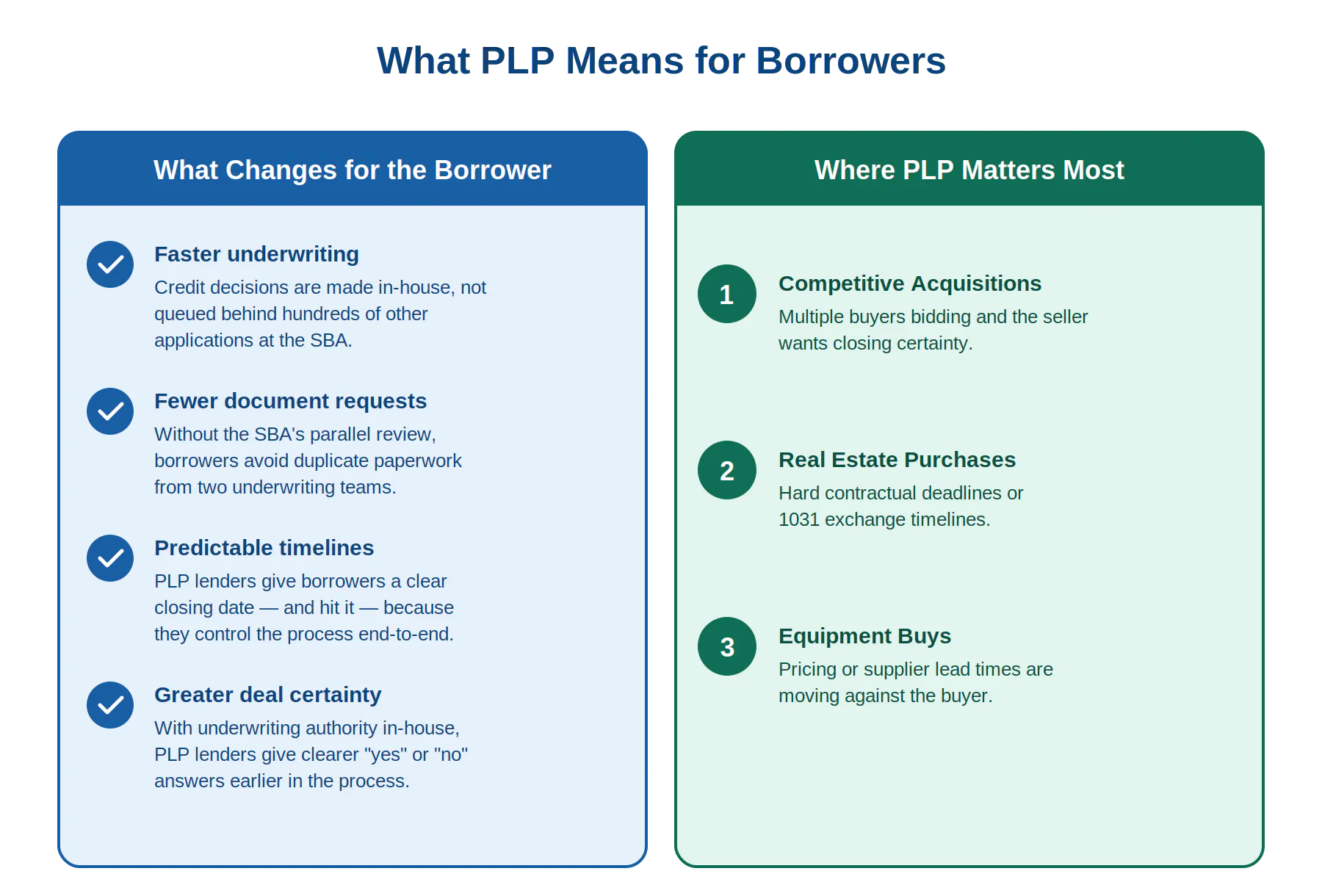
Here's what changes for the borrower:
- Faster underwriting. Credit decisions are made in-house, not queued behind hundreds of other applications at the SBA's Loan Guaranty Processing Center.
- Fewer document requests. Without the SBA's parallel review, borrowers avoid the duplicate paperwork that typically arrives in waves from two underwriting teams.
- Predictable timelines. PLP lenders can give borrowers a clear closing date — and hit it — because they control the approval process end-to-end.
- Greater deal certainty. With underwriting authority in-house, PLP lenders can give borrowers clearer "yes" or "no" answers earlier in the process.
The benefits compound when the loan is tied to a time-sensitive opportunity. A non-PLP timeline can stretch a 30-day acquisition window into a 90-day waiting game, while a PLP lender keeps the deal on schedule.
PLP status matters most in these scenarios:
- Competitive acquisitions where multiple buyers are bidding and the seller wants closing certainty.
- Real estate purchases with hard contractual deadlines or 1031 exchange timelines.
- Equipment buys where pricing or supplier lead times are moving against the buyer.
For small business owners weighing financing options, the lender's PLP status is often the difference between executing on a plan and losing an opportunity.
Step-by-Step: What to Expect When You Apply with a PLP Lender
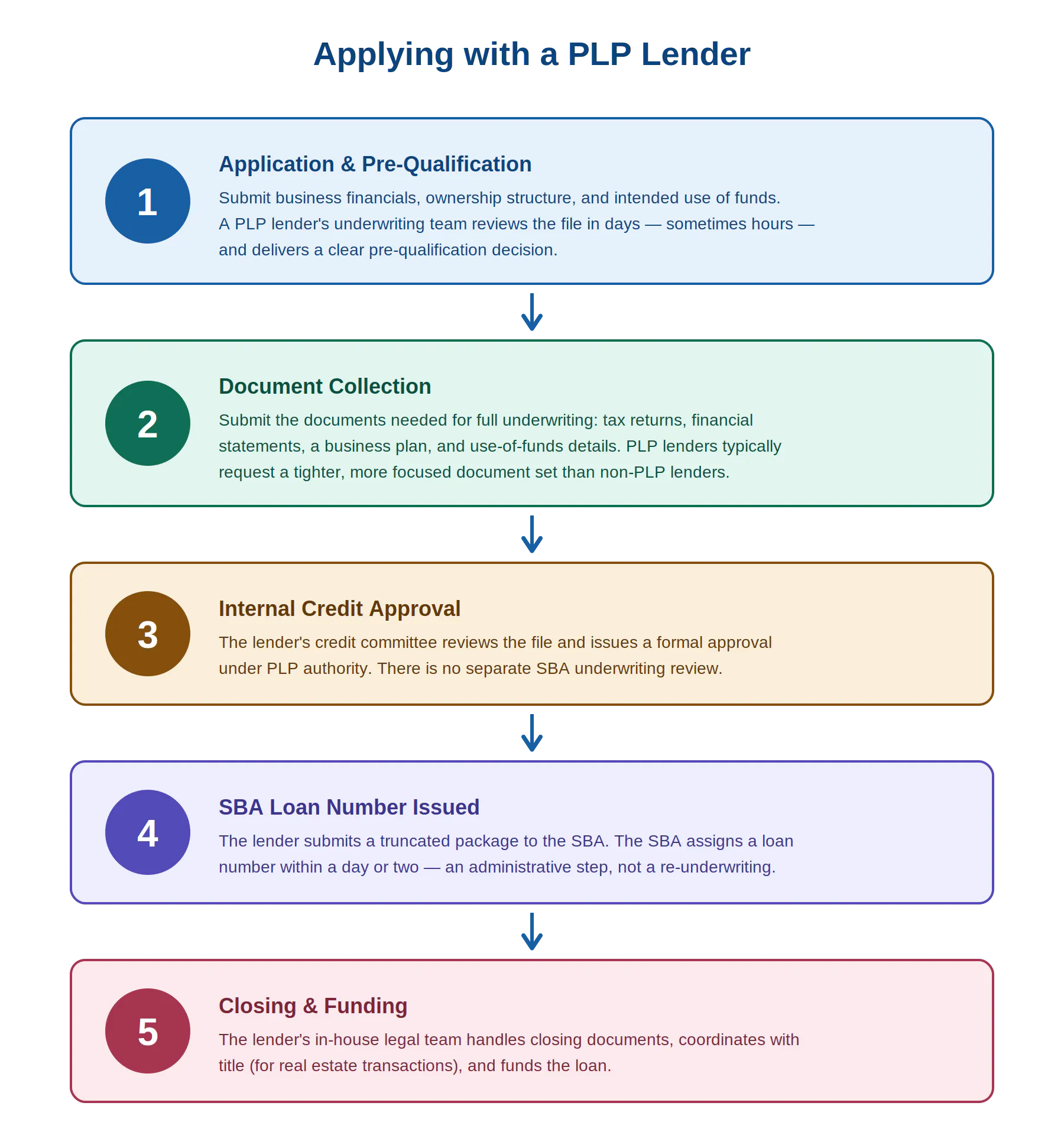
Step 1: Application & Pre-Qualification
First, the borrower submits an application. The application contains business financials, ownership structure, and intended use of funds. Within days or hours, a PLP lender’s underwriting team reviews the file and offers a clear pre-qualification decision.
Step 2: Document Collection
After pre-qualification, you submit the documents required for full underwriting: tax returns, financial statements, a business plan, and use-of-funds details. PLP lenders typically require a tighter, more focused document set than non-PLP lenders.
Step 3: Internal Credit Approval
The lender’s credit committee then reviews the file and issues a formal approval under PLP authority. There is no separate SBA underwriting review.
Step 4: SBA Loan Number Issued
The lender submits a truncated package to the SBA. The SBA assigns a loan number within a day or two. This is an administrative step, not a re-underwriting.
Step 5: Closing and Funding
The lender's in-house legal team handles closing documents, coordinates with title (for real estate transactions), and funds the loan.
No second round of underwriting. No surprise documentation requests from a third party. Just a clear path from application to capital.
SBA Preferred Lender Program: Top Use Cases
The SBA Preferred Lender Program is beneficial for any borrower, but the benefits are most pronounced in time-sensitive financing scenarios. Here are a few examples.
- Business acquisition and partner buyout. Sellers want closing certainty. A PLP lender's faster timeline strengthens your offer and reduces the risk of a deal collapsing in escrow.
- Owner-occupied commercial real estate. Real estate closings often have hard deadlines tied to seller agreements or 1031 exchanges. PLP authority keeps the financing on track.
- Equipment and machinery purchases. When equipment costs rise quickly or supplier lead times stretch, faster funding means locking in pricing before it moves.
- Construction and build-outs. Construction projects require predictable capital deployment. PLP lenders can fund draws on schedule without SBA-side delays.
For these use cases — and for borrowers in industries like assisted living, transportation, franchises, car washes, and medical offices — working with a preferred lender often determines whether a deal moves forward at all.
Close the Funding Gap with a Preferred SBA Lender Now!
Slow SBA loan timelines kill deals. The SBA Preferred Lender Program exists to fix that. This gives qualified lenders the authority to approve, close, and fund 7(a) loans without waiting on SBA underwriting.
If you're planning an acquisition, buying real estate, refinancing debt, or funding growth, the difference between a PLP and non-PLP lender can be the difference between closing quickly or waiting a quarter.
Apply for a loan with a PLP lender such as Port 51 Lending to achieve faster funding and deploy capital quicker.


