
2026-05-20
Financing a Gas Station with an SBA 7(a) Loan: A Complete Guide
By Kevin Bartley
Gas stations are one of the most resilient small business investments in America. People need fuel, snacks, and coffee no matter what the economy is doing. And the convenience store attached to the pump often outperforms the fuel sales themselves.
There are roughly 145,000 fueling stations across the United States, and a large share of them are independently owned. That means buyers and sellers are trading these businesses constantly — through acquisitions, partner buyouts, and ownership transitions.
But here's the catch. Gas stations are capital-intensive. Between the real estate, the fuel inventory, the underground storage tanks, and the convenience store buildout, the price tag climbs fast. Most buyers can't write a check that large.
That's why financing a gas station with an SBA 7(a) loan has become the go-to path for fuel and convenience store entrepreneurs. In the following blog, we'll show you how SBA 7(a) financing works for gas stations, what lenders look for, and how to get to closing fast.
Gas Station Financing: Challenges & Limitations
Buying or expanding a gas station is not like buying a typical small business. The challenges are specific, and conventional lenders often shy away.
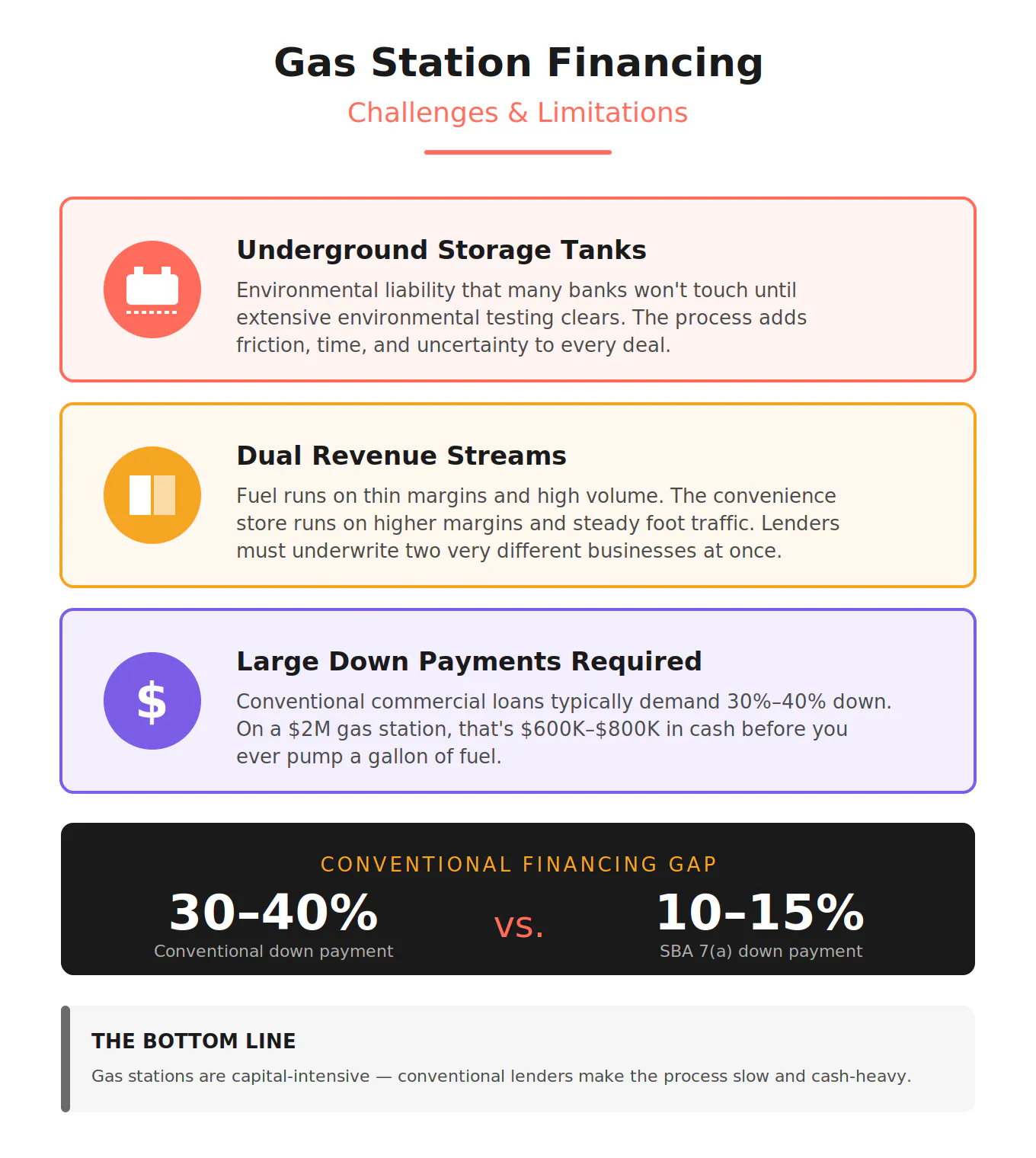
So what makes gas station financing hard? Start with the underground storage tanks. USTs are an environmental liability, and many banks won't touch a deal until extensive environmental testing clears. That testing takes time and adds friction to the process.
Then there's the fuel-versus-store revenue split. Lenders need to understand both income streams — and they're very different businesses operating under one roof. Fuel runs on thin margins and high volume. The convenience store runs on higher margins and steady foot traffic.
Conventional financing also tends to demand large down payments. A traditional commercial loan might require 30% to 40% down on a gas station acquisition. For a business selling for $2 million, that's $600,000 to $800,000 in cash before you ever pump a gallon.
Most entrepreneurs simply don't have that kind of capital sitting idle. And the ones who do often don't want to drain their reserves on a single down payment.
That's the gap. Here's how SBA 7(a) loans close it.
The SBA 7(a) Loan: Built for Gas Station Buyers
The SBA 7(a) loan is the U.S. Small Business Administration's flagship lending program. It's designed to help entrepreneurs buy, build, and grow small businesses — and gas stations fit the model perfectly.
Here's what makes it different. The SBA doesn't lend the money directly. Instead, it guarantees a large portion of the loan made by an approved lender. That guarantee reduces risk for the lender, which means they can approve deals — like gas station acquisitions — that conventional financing rejects.
For gas station buyers, that translates into three concrete advantages: lower down payments, longer repayment terms, and the ability to roll multiple costs into a single loan.
A conventional loan might demand 30% down. An SBA 7(a) loan for a gas station acquisition typically requires just 10% to 15%. That difference frees up working capital you can put toward inventory, staffing, and operations from day one.
SBA 7(a) loans also offer long repayment terms — up to 25 years when real estate is involved. Longer terms mean lower monthly payments, which protects your cash flow during the critical first years of ownership.
And the loan is flexible. A single SBA 7(a) loan can cover the real estate, the business itself, the equipment, and working capital all at once. No juggling separate financing for separate pieces.
What an SBA 7(a) Gas Station Loan Can Cover
One of the biggest reasons fuel entrepreneurs choose SBA 7(a) financing is its versatility. One loan can finance nearly every part of a gas station transaction.
Here’s what you can finance with a SBA 7(a) loan: Business acquisitions — the purchase of an existing gas station, including partner buyouts and management buyouts in a change of ownership.
- Owner occupied commercial real estate – buy the land and the station.
- Equipment and machinery – fuel dispensers, point-of-sale systems, coolers, car wash equipment, and underground storage tank upgrades.
- Build-outs and construction – adding a c-store, expanding the forecourt or constructing a new location from scratch.
- Working capital — fuel inventory, store stock, payroll, and the everyday cash you need to operate.
That versatility matters. A gas station purchase often bundles real estate, a business, equipment, and inventory into one transaction. Financing each piece separately is slow and expensive. One SBA 7(a) loan ties it together.
SBA 7(a) Gas Station Loan: Rates, Terms & Down Payment
Numbers matter when you're evaluating a loan. Here's what financing a gas station with an SBA 7(a) loan actually looks like.
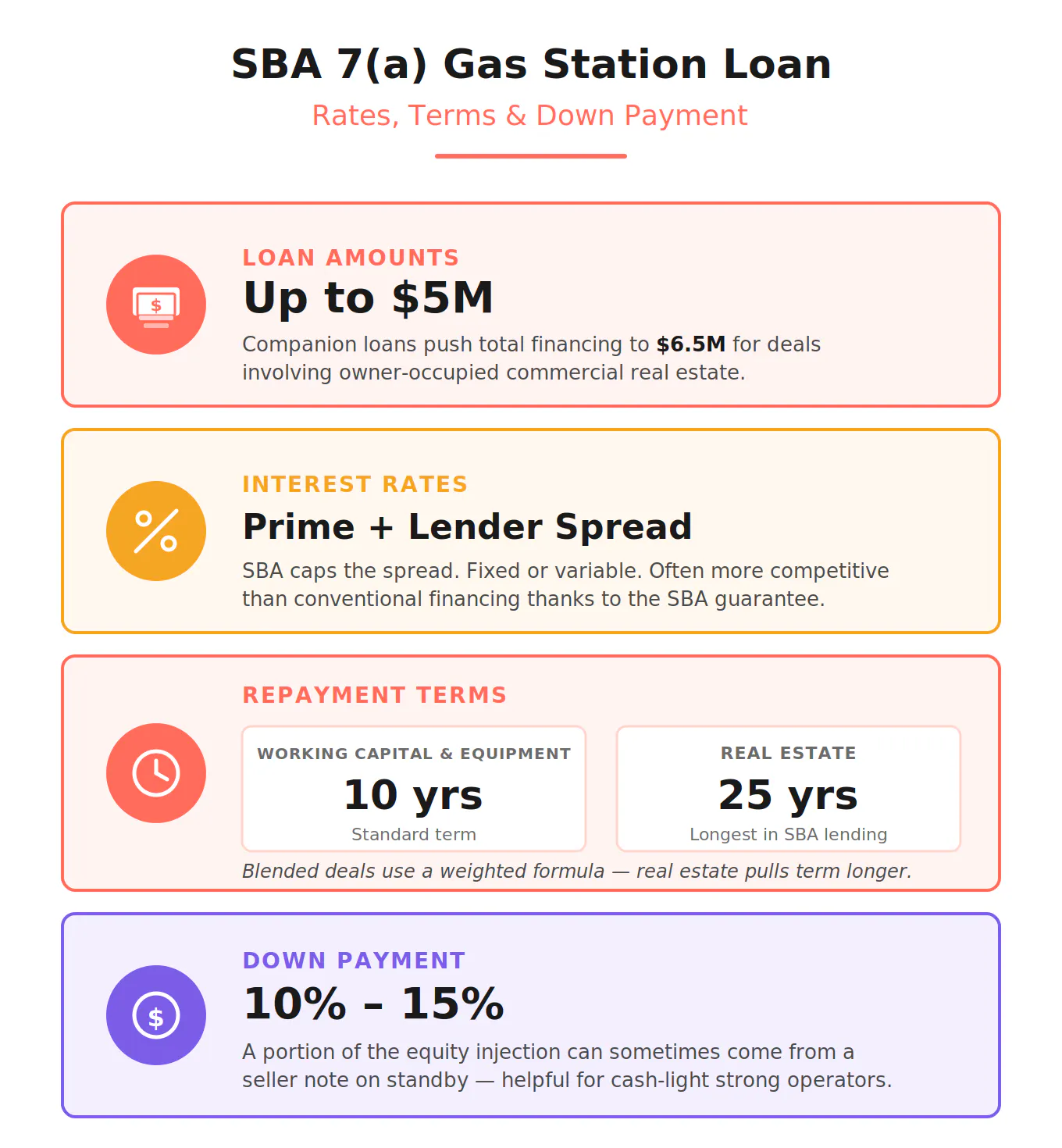
Loan amounts. SBA 7(a) loans go up to $5 million. For larger deals involving owner-occupied commercial real estate, companion loans can push total financing to $6.5 million — enough to cover most independent gas station and convenience store acquisitions.
Interest rates. SBA 7(a) rates are tied to the Prime Rate plus a lender spread, and the SBA caps how high that spread can go. Rates can be fixed or variable. Because the SBA guarantee lowers lender risk, SBA 7(a) rates are often more competitive than what an independent gas station buyer would find through conventional financing.
Repayment terms. Working capital and equipment portions are typically repaid over 10 years. Real estate portions stretch up to 25 years. When a deal blends both, the SBA uses a weighted formula — but the real estate component pulls the term longer, which keeps payments manageable.
Down payment. Expect to put down 10% to 15% on a gas station acquisition. The SBA requires a minimum equity injection, and a portion can sometimes come from a seller note on standby. That flexibility helps buyers who are strong operators but light on cash.
For the official program rules, the SBA's 7(a) loan page lays out the current standards.
Do You Qualify? Gas Station SBA 7(a) Loan Eligibility
Before you start a deal, it helps to know what lenders look for. SBA 7(a) eligibility for a gas station comes down to a handful of factors.
The business must qualify as a small business. The SBA sets size standards, and the vast majority of independent gas stations and convenience stores fall well within them.
It must be a for-profit business operating in the U.S. Gas stations clearly qualify. The business also has to be one the SBA is willing to finance — and fuel and convenience retail is squarely on the approved list.
You'll need reasonable credit and relevant experience. Lenders want to see a credit history that shows you pay your obligations. Industry experience helps — if you've run a convenience store or managed retail before, that strengthens your file. First-time buyers can still qualify with a solid business plan and the right deal structure.
The deal has to be cash flow. This is the big one. Lenders analyze whether the gas station generates enough income to cover the loan payments with room to spare. They look at fuel margins, store revenue, and historical financials.
So what if you've never owned a gas station before? You can still qualify. A strong operator with a good deal and a clear plan often gets approved — especially with a lender that focuses on cash flow and structure rather than rigid formulas.
A flexible credit philosophy makes the difference here. The best SBA lenders evaluate real-world business performance, not just a checklist. To go deeper on the approval process, see our guide on how to qualify for an SBA 7(a) loan.
How to Finance a Gas Station with an SBA 7(a) Loan: Step by Step
Here's a step-by-step guide on how to move from interest to closing.
Step 1: Find the Right Gas Station Deal
First, begin with the business itself. Whether you're buying an existing station or expanding your current one, gather the financials — at least two to three years of tax returns, profit-and-loss statements, and fuel volume reports.
Look closely at the revenue split between fuel and the convenience store. A station with a strong store and steady inside sales is often a more durable investment than one leaning entirely on fuel margins.
Step 2: Get Pre-Qualified with an SBA Lender
Before you go too deep, talk to an SBA lender. A pre-qualification tells you how much you can borrow and what the deal structure looks like.
Choose a lender with gas station experience. A lender that has financed fuel and convenience deals before knows how to handle USTs, environmental reports, and the fuel-versus-store revenue analysis. That experience speeds everything up.
Step 3: Submit Your Application and Documentation
Now you'll assemble the full application. Expect to provide business and personal financial statements, tax returns, the purchase agreement, and a business plan.
Working with a Preferred Lender Program (PLP) lender matters here. PLP lenders can process SBA loans in house, meaning less back and forth, and a faster turnaround. That cuts weeks off the timeline.
Step 4: Complete Environmental Due Diligence
Because gas stations have underground storage tanks, the SBA requires environmental due diligence. This usually starts with a records review and may move to deeper testing depending on what's found.
This step is unavoidable — but an experienced lender keeps it moving and knows what the SBA needs. Don't let it surprise you. Plan for it from the start.
Step 5: Close the Loan and Take Ownership
Once underwriting and environmental review clear, you move to closing. A lender with an in-house legal team can reduce closing costs and keep the process tight.
With the right lender, financing a gas station with an SBA 7(a) loan can close in under a month. Then the keys — and the pumps — are yours.
The Benefits of SBA 7(a) Gas Station Financing
Financing a gas station with an SBA 7(a) loan delivers real, measurable advantages over conventional financing.
Lower upfront cost. You keep your down payments at 10% to 15% instead of 30% or more – tens of thousands of dollars in your pocket that you can put toward inventory and operations.
Greater cash flow. Repayment terms up to 25 years mean lower monthly payments, protecting your business during the early years when cash is tight.
One loan, every cost. Real estate, business, equipment, and working capital roll into a single SBA 7(a) loan — no stacking separate financing for separate pieces.
For most independent fuel and convenience store entrepreneurs, those three benefits decide the deal.
Finance Your Gas Station with an SBA 7(a) Loan Now!
Gas stations are capital-intensive, and conventional lenders make the process slow and cash-heavy. Financing a gas station with an SBA 7(a) loan closes that gap — with lower down payments, longer terms, and a single loan that covers the whole deal.
As a nationwide direct SBA lender and Preferred Lender Program participant, we specialize in fuel and convenience store financing — with an in-house legal team and an average time-to-close of just 27 days. Get started with your gas station SBA 7(a) loan today and talk to a lending specialist who knows the industry.


