2026-05-07
SBA 7(a) Down Payment Sources: What's Allowed & What's Not
By Kevin Bartley
SBA 7(a) loans are one of the most accessible ways for small business owners to secure capital. The program offers longer terms, lower down payments, and competitive rates compared to conventional loans. SBA 7(a) loans also support a wide range of business needs, from acquisitions to commercial real estate to working capital. But before borrowers can take advantage of these benefits, they need to understand the down payment requirements.
SBA 7(a) down payment sources work differently than those for conventional loans. Conventional lenders often accept any documented funds, with little scrutiny on where the money came from. The SBA takes a stricter approach. Every dollar of the down payment must be traceable, properly documented, and drawn from approved sources.
In the following blog, we'll explain how SBA 7(a) down payment sources work, which funds qualify, which ones don't, and how borrowers can structure their equity injection to meet SBA requirements.
How SBA 7(a) Down Payment Rules Differ From Conventional Loans
Conventional small business loans and SBA 7(a) loans handle down payments in fundamentally different ways. Conventional lenders focus on the amount the borrower brings to closing and whether the funds clear in time. The SBA cares about the amount, the source, and the paper trail behind every dollar.
Conventional lenders accept a wider range of funding without deep verification. Borrowers can usually combine personal savings, a personal loan, or a credit line to cover the down payment, as long as the total clears at closing. Lenders may ask for proof of funds, but they rarely audit the origin of the money. This flexibility comes at a cost. Conventional small business loans often require down payments of 20% to 30%, with shorter repayment terms and higher interest rates than SBA 7(a) loans.
SBA 7(a) loans take the opposite approach. The down payment is lower, often as little as 10%, but the SBA inspects every source. Borrowers must document the origin of each dollar through bank statements, gift letters, sale records, or rollover paperwork. Funds also need to be seasoned in the borrower's account, generally for at least two months, before they qualify as approved equity injection.
The SBA also restricts certain funding methods that conventional lenders might allow. Credit card advances, unsecured personal loans, and undocumented cash deposits are off the table for SBA 7(a) borrowers. Seller financing, which rarely factors into conventional deals, can play a major role in SBA acquisitions when structured correctly.
These rules exist for a reason. The SBA guarantees a large portion of every 7(a) loan, which means taxpayer dollars are at risk if borrowers default. The strict sourcing rules confirm that borrowers have real skin in the game and the financial stability to repay the loan. For borrowers who plan ahead and document their funds correctly, the trade-off is access to financing terms that conventional lenders simply cannot match.
What Is an SBA 7(a) Down Payment?
The SBA 7(a) program requires borrowers to contribute their own money toward the deal. This contribution is called the equity injection. It shows the borrower has personal investment in the business and reduces the lender's risk on the loan.
For most SBA 7(a) loans, the down payment falls between 10% and 20% of the total project cost. The exact percentage depends on the type of deal:
- Business acquisitions: At least 10% equity injection under current SBA guidelines
- Commercial real estate purchases: 10% to 15%
- Startups: Up to 30%, depending on the lender and the industry
But the SBA cares about more than just the amount. The SBA also wants to know where the money came from. Every dollar of the borrower's equity injection must be documented and traceable. Lenders verify the source through bank statements, gift letters, tax returns, and other records before closing.
Approved SBA 7(a) Down Payment Sources
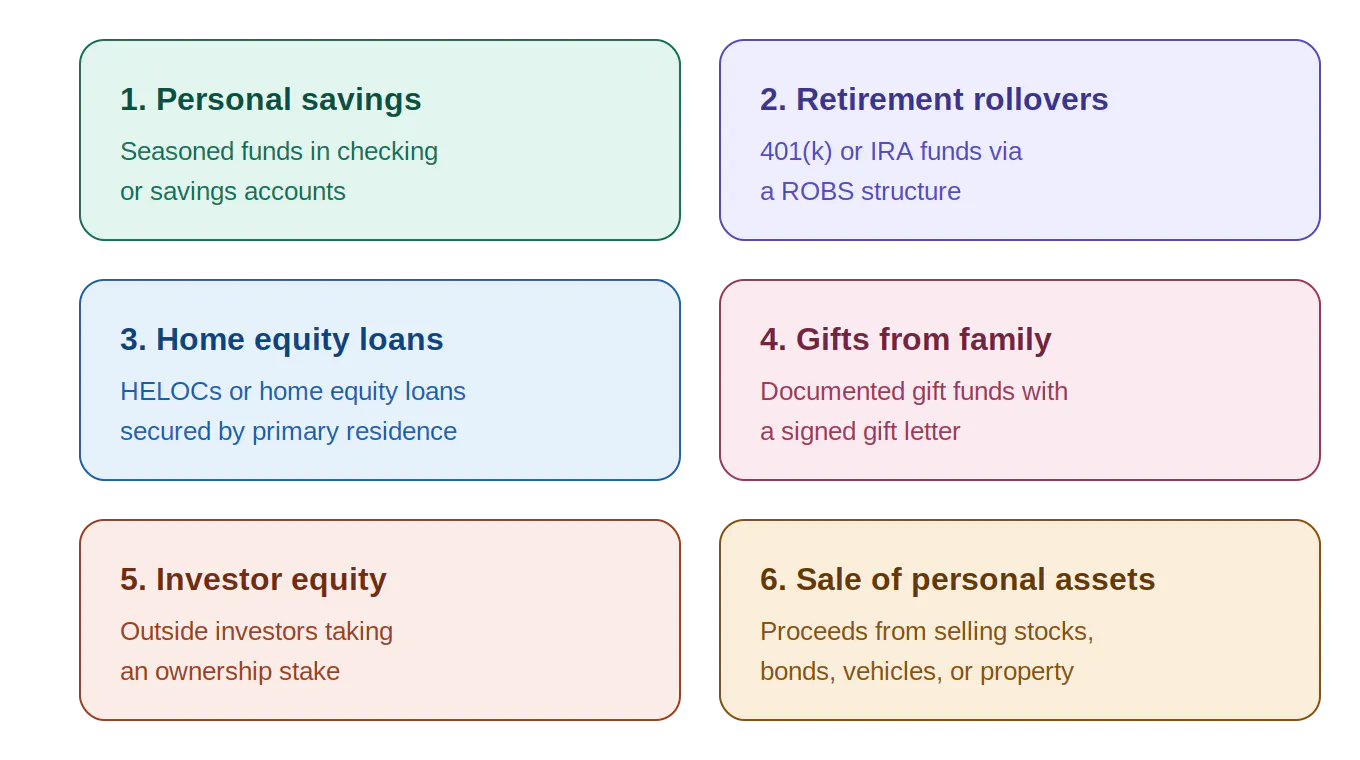
The SBA accepts a range of funding sources for the borrower's equity injection. The following sources consistently meet approval requirements when documented correctly.
Personal Savings and Checking Accounts
Personal savings are the most straightforward source for SBA down payments. Money sitting in the borrower's bank account, ideally for at least two months before closing, is the cleanest source available. Lenders refer to these as seasoned funds.
Borrowers will need to provide two to three months of bank statements showing the funds. Large recent deposits will trigger questions, so borrowers should be prepared to explain where any unusual transfers came from. Funds that have been in the account for 60 days or more typically do not require additional sourcing documentation.
This is the easiest path because it requires no extra paperwork beyond standard bank statements. If the borrower has been saving for years to buy a business, this money works without restrictions.
Retirement Account Rollovers
Borrowers can use their 401(k), IRA, or other retirement funds as a down payment source through a process called a Rollover for Business Startups, or ROBS. This structure allows borrowers to access retirement money without paying early withdrawal penalties or income taxes.
ROBS arrangements involve creating a C-corporation, establishing a new retirement plan, and rolling existing retirement funds into the new plan. The plan then invests in the business. The IRS and Department of Labor regulate these structures closely, so borrowers need a specialized provider to set one up correctly.
Borrowers can also take a direct distribution from their retirement account, but this triggers taxes and a 10% penalty if they are under 59½. Most borrowers prefer the ROBS structure to preserve the full value of their retirement savings.
Home Equity Loans and HELOCs
Tapping home equity is a common way for borrowers to fund an SBA down payment. A home equity loan or home equity line of credit (HELOC) allows borrowers to borrow against the value of their primary residence.
The SBA allows this source, but lenders factor the new debt payment into the borrower's personal cash flow analysis. If the additional monthly payment stretches the borrower's personal finances too thin, it can affect loan approval. Borrowers will need to qualify for both the home equity loan and the SBA loan based on their overall financial picture.
Home equity offers lower interest rates than other borrowed sources, making it attractive for borrowers with significant equity built up. But borrowers should remember that they are pledging their home as collateral for that money.
Gifts From Family Members
Gift funds from family members are an approved SBA 7(a) down payment source. The SBA requires a signed gift letter stating that the money is a true gift with no expectation of repayment. The letter must include the giver's name, relationship to the borrower, the gift amount, and confirmation that no repayment is required.
Lenders also verify the gift through bank statements showing the transfer from the giver's account to the borrower's. Some lenders require statements from the donor's account proving they had the funds available. The money must be fully transferred and seasoned in the borrower's account before closing.
If the funds are actually a loan disguised as a gift, that is mortgage fraud. Lenders identify these inconsistencies during their review process.
Investor Equity
Borrowers can bring on a business partner or outside investor who contributes equity to the deal. The investor's contribution counts toward the equity injection if they are taking an ownership stake in the business.
Anyone owning 20% or more of the business will need to personally guarantee the SBA loan. This means the investor signs the guarantee alongside the borrower. They also go through the same credit and background checks the borrower does. Many investors are hesitant to take on personal liability, so structuring these deals requires careful conversations upfront.
The investor's contribution must be true equity, not a loan to the business. If the money is structured as debt, it does not qualify as equity injection.
Sale of Personal Assets
Selling personal assets like stocks, bonds, vehicles, or real estate can fund the borrower's down payment. The proceeds count as the borrower's own funds once the sale is complete.
Borrowers will need documentation showing the sale, the proceeds, and the deposit into their account. Brokerage statements, bills of sale, and title transfers all serve as proof. The funds should settle in the account a few weeks before closing to avoid last-minute verification issues.
If the borrower sells investments, they should also factor in any capital gains taxes they might owe. The amount they net after taxes is what they have available for the equity injection.
Conditionally Approved Sources
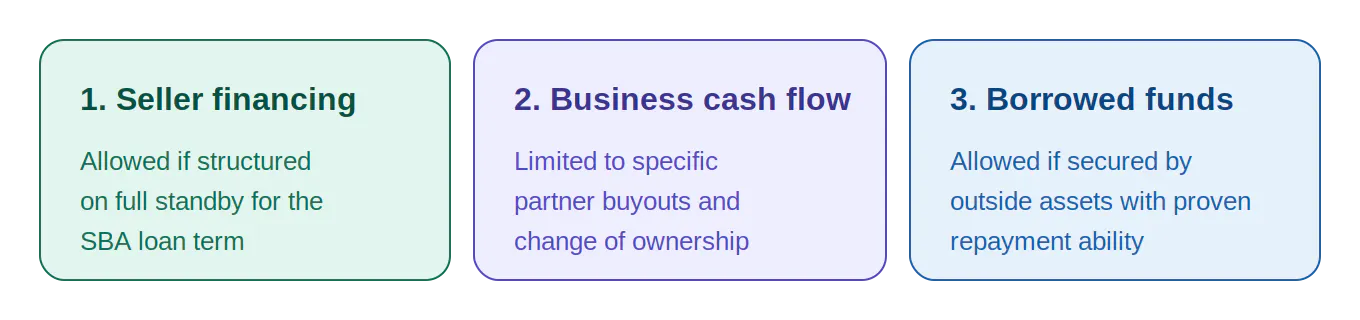
Some SBA 7(a) down payment sources are allowed but come with specific rules. These require careful structuring to qualify.
Seller Financing
Seller financing is one of the most useful structures in business acquisition deals. The seller agrees to carry a portion of the purchase price as a note, which the buyer pays back over time. Under SBA 7(a) rules, seller financing can count toward the borrower's equity injection, but only under specific conditions.
For seller debt to count as part of the equity injection, it must be on full standby for the entire 10-year term of the SBA loan. Full standby means the seller receives no payments of principal or interest during that period. If the seller debt is on partial standby with interest-only payments, it does not count toward the required equity injection. It is still allowed as part of the deal structure.
When structured correctly, a seller note on full standby can cover up to half of the borrower's required equity injection. This means the borrower might only need to bring 5% cash to a deal that requires a 10% down payment. Seller financing is a major reason buyers choose SBA 7(a) loans for business acquisitions over conventional financing.
Business Cash Flow
For existing businesses being acquired, retained earnings or cash from the business itself cannot serve as the buyer's equity injection. The buyer needs to bring outside funds. The business can use its own cash for working capital needs separate from the down payment.
There are exceptions for partner buyouts and certain change of ownership scenarios where the business itself contributes to the transaction. These deals require careful structuring and experienced lenders who understand the nuances of SBA rules.
Borrowed Funds From Other Sources
The SBA generally does not allow borrowers to borrow their equity injection from another source. The down payment is meant to represent the borrower's own money at risk in the business. But there are exceptions.
Borrowed funds are allowed if the loan is secured by assets other than the business being financed and the borrower can prove the ability to repay the new loan from sources outside the business. A personal loan secured by a home or investment portfolio might qualify under these conditions. An unsecured personal loan or credit card advance generally will not.
This is one of the more nuanced areas of SBA rules, and lenders interpret it differently. Borrowers should confirm with their lender before assuming borrowed funds will be accepted.
Sources That Are Not Allowed
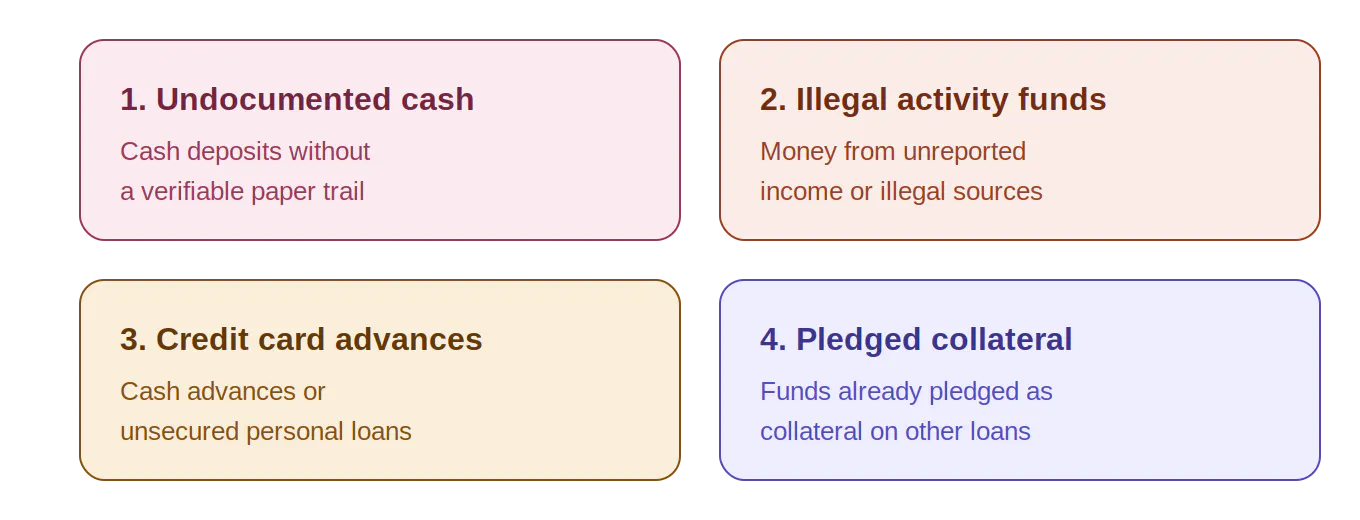
Some funding sources will get the borrower's SBA 7(a) application denied. Borrowers should avoid these completely.
If the borrower cannot prove where the down payment came from, the SBA will not accept it. Cash with no documented source is one of the biggest red flags for SBA underwriters. Cash deposits without a paper trail raise concerns about money laundering and fraud. Every dollar must be traceable to a legitimate source. If the borrower has been holding cash at home, they should deposit it into a bank account at least two to three months before applying for the loan. Funds need time to season before they appear as normal account balances rather than recent deposits.
The SBA strictly prohibits funds from illegal activities under any circumstances. This includes unreported income, proceeds from illegal activities, and money that violates federal regulations. Cannabis-related income, even from state-legal businesses, creates major complications because cannabis remains federally illegal.
Credit card advances and unsecured loans do not qualify as SBA down payment sources. The SBA wants to see real equity, not borrowed money that adds to the borrower's debt burden. These sources also signal that the borrower may not have the financial stability to manage a small business loan.
Another common mistake is relying on funds already pledged as collateral for other loans, which cannot serve as the borrower's equity injection. The funds must be unencumbered and available to support the new venture.
How to Document a Down Payment
Every dollar of the borrower's equity injection needs documentation. Lenders use this paperwork to verify that the funds come from approved sources and that the borrower is meeting SBA requirements. Missing or unclear documentation is one of the top reasons SBA loans get delayed at closing.
For personal savings, borrowers should expect to provide two to three months of bank statements from every account they plan to use. The statements should show consistent balances and clearly identify the account holder. If any large deposits appear during that period, borrowers will need to explain the source with supporting records, such as a paycheck stub, sale receipt, or transfer confirmation.
For gift funds, the borrower needs a signed gift letter from the family member providing the money. The letter must include the giver's name, relationship to the borrower, the gift amount, and confirmation that no repayment is required. Lenders also require bank statements showing the transfer from the giver's account to the borrower's account. Some lenders ask for statements from the donor's account to confirm they had the funds available.
For retirement rollovers, the ROBS provider supplies most of the necessary documentation. This includes the formation documents for the new C-corporation, the new retirement plan, and records of the rollover transaction. Borrowers should also provide statements from the original retirement account showing the funds before and after the rollover.
For home equity loans and HELOCs, lenders need the loan agreement, the closing disclosure, and bank statements showing the funds deposited into the borrower's account. The lender will also factor the new monthly payment into the borrower's personal cash flow analysis.
For asset sales, borrowers need bills of sale, brokerage statements, or title transfers showing the sale and the proceeds. The deposit of those proceeds into the borrower's account also needs to appear on a bank statement. If the asset sale triggered capital gains taxes, borrowers should be ready to show how those taxes will be paid without dipping into the equity injection.
For investor equity, the lender will want a written agreement outlining the investor's contribution and ownership stake. Investors holding 20% or more of the business will also need to provide personal financial statements, tax returns, and credit information as part of the personal guarantee process.
Borrowers should start gathering these documents before submitting an application. Working with an experienced SBA 7(a) lender helps borrowers anticipate documentation requirements before they become problems. Organized paperwork keeps the process moving and improves the borrower's chances of closing on time.
Common Down Payment Challenges and How to Solve Them
Even borrowers with strong financials can run into trouble when assembling their SBA 7(a) down payment. Most issues come down to timing, documentation, or misunderstanding what the SBA will accept. Identifying these challenges early gives borrowers time to fix them before they delay the loan.
One of the most common issues is unseasoned funds. The borrower may have the right amount of money in their account, but if it arrived recently, the lender will require proof of where it came from. Large deposits made within 60 days of application often trigger additional documentation requests. To avoid this, borrowers should move funds into a single account at least two to three months before applying for the loan.
Documentation gaps are another frequent cause of delays at closing. The borrower might forget to request a gift letter, lose track of a brokerage statement, or fail to document the sale of a personal asset. Each missing piece extends the timeline and frustrates everyone involved. Borrowers should build a documentation checklist at the start of the application process, covering bank statements, gift letters, sale records, and rollover paperwork for retirement funds.
Some borrowers hold significant cash savings outside the banking system. Depositing that money close to the application date creates problems, since cash deposits without documented sources raise red flags and often get excluded from the equity injection calculation. The fix is straightforward but requires patience. Borrowers should deposit cash into their account at least two to three months before applying, and keep records of where the cash originated.
Borrowers sometimes plan to use funding sources the SBA does not allow, such as credit card advances, unsecured personal loans, or funds already pledged as collateral. Discovering this late in the process can force the borrower to scramble for replacement funds or restart the application. Experienced SBA lenders can flag problems in the first conversation and suggest approved alternatives. The best prevention is early communication with the lender about every potential funding source.
Some borrowers also underestimate how much cash they need at closing. They focus on the minimum 10% down payment without accounting for closing costs, working capital, or reserves the lender may require. The result is a funding gap that can derail the deal. To avoid this, borrowers should ask their lender for a complete breakdown of all required funds at closing, including the equity injection, fees, and any post-closing reserves.
Finally, many borrowers combine several funding sources to meet their down payment, such as personal savings, a seller note on full standby, and a gift from a family member. Coordinating the timing and documentation across multiple sources adds complexity and increases the risk of errors. A practical solution is to build a simple funding map that lists each source, the amount, the documentation required, and the expected timeline for transfer. Sharing this map with the lender early in the process keeps everyone aligned and helps spot issues before they become deal-breakers.
Combining Multiple Down Payment Sources
Most borrowers do not rely on a single source for their equity injection. A typical deal might combine personal savings, a seller note on full standby, and gift funds from a family member. The SBA allows borrowers to mix and match approved sources as long as each one is properly documented.
The key is making sure every component meets SBA requirements individually. A 10% equity injection that includes 5% seller debt on full standby and 5% personal savings works fine. A 10% injection that includes 5% borrowed from an unsecured loan and 5% personal savings might not qualify.
Borrowers should discuss their funding structure with the lender early in the process. The lender can help organize the deal to maximize approval chances and reduce the cash needed at closing.
Build the Right Equity Injection for an SBA 7(a) Loan
The borrower's SBA 7(a) down payment sources matter as much as the amount they contribute. Personal savings, retirement rollovers, home equity, gifts from family, and investor equity all qualify when documented correctly. Seller financing on full standby can reduce the cash requirement significantly for acquisition deals. Borrowed funds, undocumented cash, and credit card advances will not work.
The right structure can mean the difference between closing in 30 days and getting denied after months of work. Before starting the application process, borrowers should map out where each dollar of the equity injection will come from and what documentation can be provided for it.
Working with a lender who specializes in SBA 7(a) loans makes the process far smoother. An experienced lender knows how to structure the equity injection, what documentation to gather, and how to navigate the nuanced areas of SBA rules.


