
2026-05-13
SBA 7(a) Personal Guarantee Requirements: What Borrowers Need to Know
By Kevin Bartley
A personal guarantee requires you to personally pay back an SBA 7(a) loan if your business is unable to. Personal guarantees pierce the protections that LLCs and corporations typically enjoy, and hold you personally responsible for paying back the loan.
Lenders can pursue your personal assets if the business defaults. This includes savings, investments, real estate, or even your home. The guarantee is in effect for the full term of the loan, which can run up to 25 years.
The SBA does not lend directly. It guarantees a portion of loans issued by approved lenders — up to 85% on smaller loans and 75% on larger ones. In exchange for that government backing, the SBA requires lenders to collect personal guarantees from anyone with meaningful ownership in the business.
In the following section, we’ll review who is responsible for personal guarantees in terms of SBA 7(a) loans.
SBA 7(a) Personal Guarantee Requirements: Who Has to Sign?
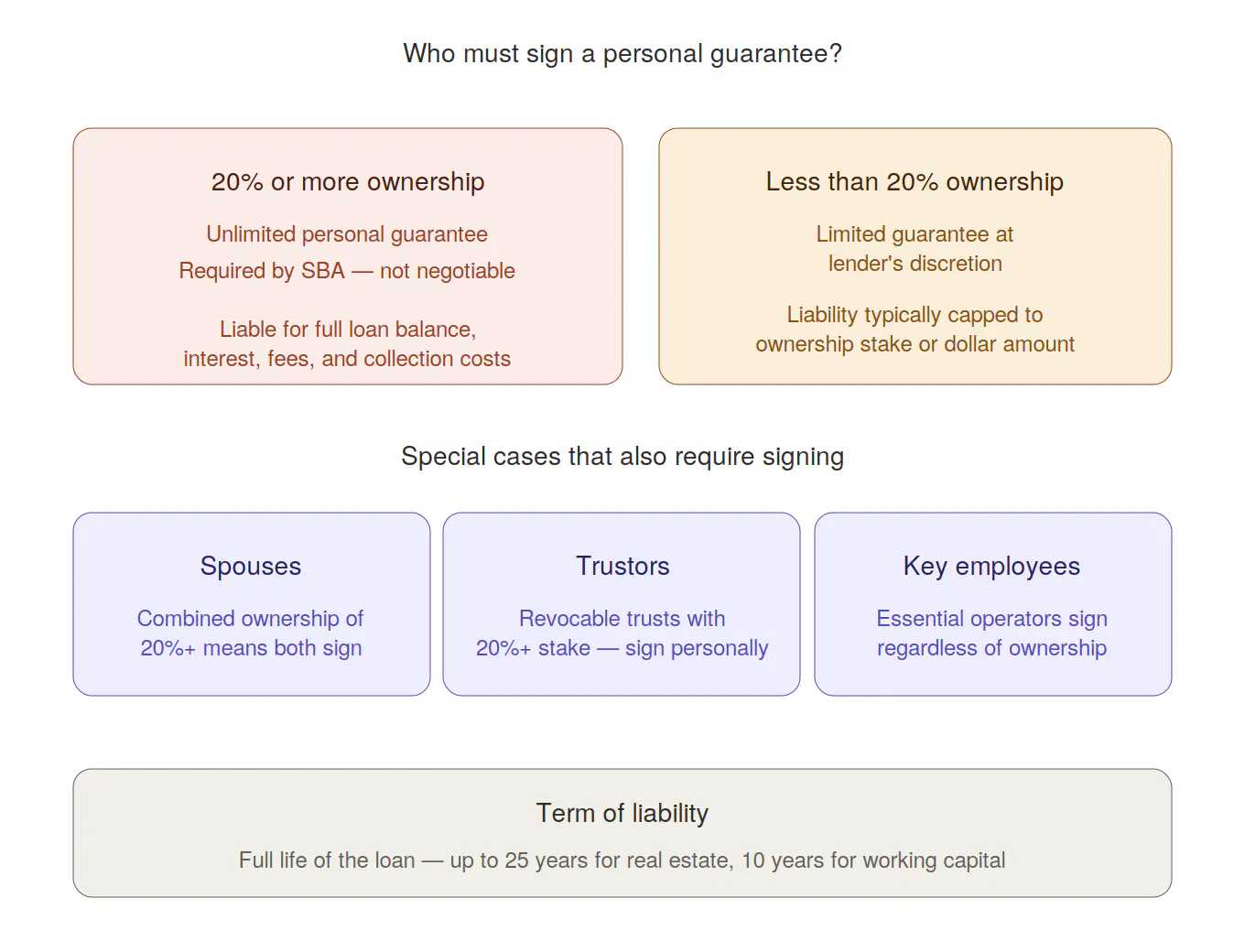
The rules on who must guarantee are spelled out in SOP 50 10, the standard operating procedure that governs the 7(a) program. The threshold is straightforward. Anyone owning 20% or more of the borrowing business must provide an unlimited personal guarantee.
This applies whether you're a sole proprietor, a 50/50 partner, or one of three equal owners. If your stake hits the 20% mark, you must sign the personal guarantee. A few additional rules round out the requirements:
- Owners holding less than 20% may be required to provide a limited guarantee at the lender's discretion.
- Spouses who together own 20% or more must both sign, even if one individually owns less than 20%.
- Trustors of revocable trusts holding 20% or more must sign personal guarantees as well.
Key employees considered essential to the business may be required to guarantee regardless of ownership.
For business acquisitions and partner buyouts — two of the most common uses of SBA 7(a) financing — every meaningful stakeholder must sign the agreement.
Unlimited vs. Limited Personal Guarantees
The distinction between unlimited and limited guarantees matters more than most borrowers realize at signing.
Unlimited personal guarantee means you are responsible for the full remaining balance on the loan, plus interest, fees, and collection costs. There’s no distinction between owning 20% of the business or 100% -- your liability is the entire debt.
A limited personal guarantee caps your liability at a specific dollar amount or percentage, usually tied to your ownership stake. Limited guarantees only come into play for sub-20% owners when deemed necessary by the lender.
What Assets Are at Risk?
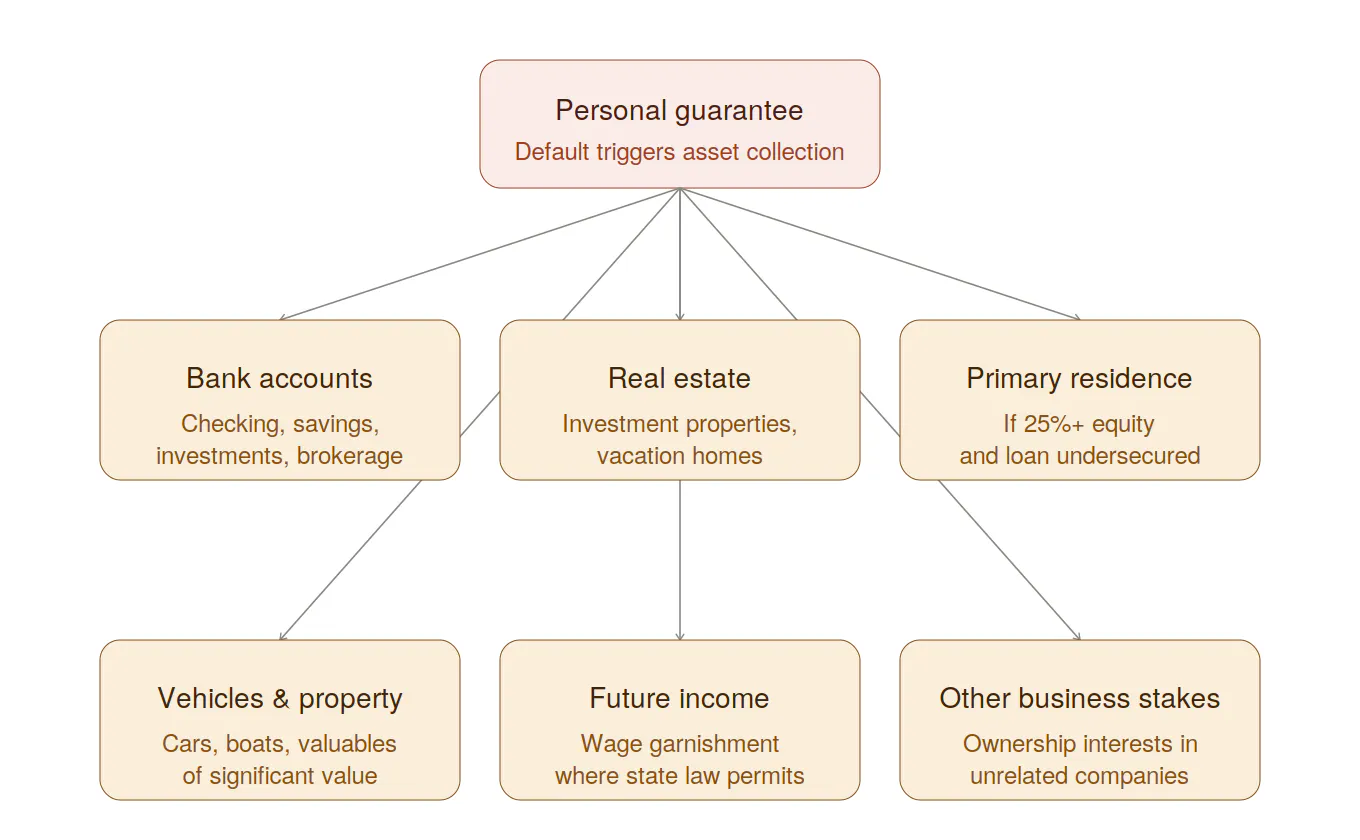
A personal guarantee gives the lender the right to pursue your assets in the event of default. Generally, the following are subject to collection:
- Personal bank accounts and investment accounts
- Real estate other than your primary residence (in some states, including primary residence)
- Vehicles and personal property of significant value
- Future income through wage garnishment, where state law permits
The SBA also requires lenders to take available collateral before the loan closes. If the personal residence of a 20%+ owner has at least 25% equity, the SBA typically requires a lien on the home for unsecured loans.
How Long Does the Personal Guarantee Last?
The personal guarantee remains in force for the entire lifecycle of the loan. For SBA 7(a) loans, that can mean a decade or more of personal liability. This is 25 years for owner-occupied real estate, and up to10 years for business acquisitions, equipment, and most working capital.
The guarantee does not expire when you sell your stake in the business.
If you exit the company but the loan remains outstanding, you generally remain personally liable unless the lender formally releases you. This requires lender approval and, in most cases, a qualified replacement guarantor.
That's why exit planning needs to start with the personal guarantee, not with the sale terms.
Can SBA 7(a) Personal Guarantee Requirements Be Negotiated?
In most cases, personal guarantee requirements cannot be negotiated, but there are exceptions. The 20% threshold is set by the SBA, not the lender, and it cannot be waived. The form and scope of the guarantee, however, has some room for discussion in specific circumstances:
- Limited guarantees for sub-20% owners. The lenders have the discretion to require this and to scope it.
- Collateral and lien requirements. If your home has less than 25% equity, then the SBA’s residential lien requirement may not apply.
- Spouse Guarantees. When a spouse owns less than 5% of the business and is not actively involved, lenders sometimes have flexibility.
- Release provisions. Some lenders will negotiate conditions under which a guarantor can be released.
A lender with a flexible credit philosophy will often find structures that protect the loan while easing the guarantor's exposure where the SBA's rules allow.
The Trade-Off: Why Borrowers Sign Anyway
For all the weight of the personal guarantee, SBA 7(a) loans remain one of the most powerful financing tools available to small business owners. The trade-off is real, and most borrowers come out ahead.
Consider what the guarantee unlocks:
- Loan amounts up to $5 million, with companion loan structures pushing total capital higher
- Down payments as low as 10% on business acquisitions
- Terms up to 25 years, dramatically lowering monthly payments
- Time-to-close under 30 days with the right lender
For a business owner buying out a partner, acquiring a competitor, or funding a major expansion, the leverage SBA 7(a) provides is hard to match. The personal guarantee is the price of admission.
A Preferred Lender Program (PLP) lender — with delegated authority from the SBA — can move that process faster, often closing in under a month even with full personal guarantee documentation in play.
Get Started with Your SBA 7(a) Loan Now!
The personal guarantee is the most consequential signature you'll make in the SBA 7(a) process. It's also the gateway to financing that can transform your business — from a partner buyout to a real estate purchase.
Port 51 Lending offers SBA expertise, in-house legal capability, and a credit philosophy built for real-world business needs. Apply now for an SBA 7(a) loan at Port 51 Lending to get funded in less than a month, on average.


